
Is tooling made in-house or bought in?
This is the first question, because it determines what happens when something goes wrong. A supplier with its own toolroom can correct a mould, adjust a gate, repair a damaged slide or modify cooling without negotiating with a third party or shipping steel somewhere. A supplier who subcontracts tooling is dependent on someone else's schedule at exactly the moment you need speed.
It also affects the quality of design review. A moulder who builds tools tends to raise manufacturability issues early, because they will personally have to solve them.
Krishnaraj Enterprises manufactures moulds and moulds components in the same facility, which is why tool design, tool manufacture and production moulding are described as a single workflow rather than separate services.
Does the machine range suit your part?
Ask what clamping forces are available and what the part would run on. A component that needs 120 tonnes running on a 380-tonne machine is being produced inefficiently, and one that genuinely needs 380 tonnes cannot run at all on a smaller press.
Also ask about machine type. Horizontal machines cover most work; vertical machines are relevant when inserts have to be loaded into the tool; all-electric machines offer tighter shot-to-shot repeatability, which matters for precision parts.
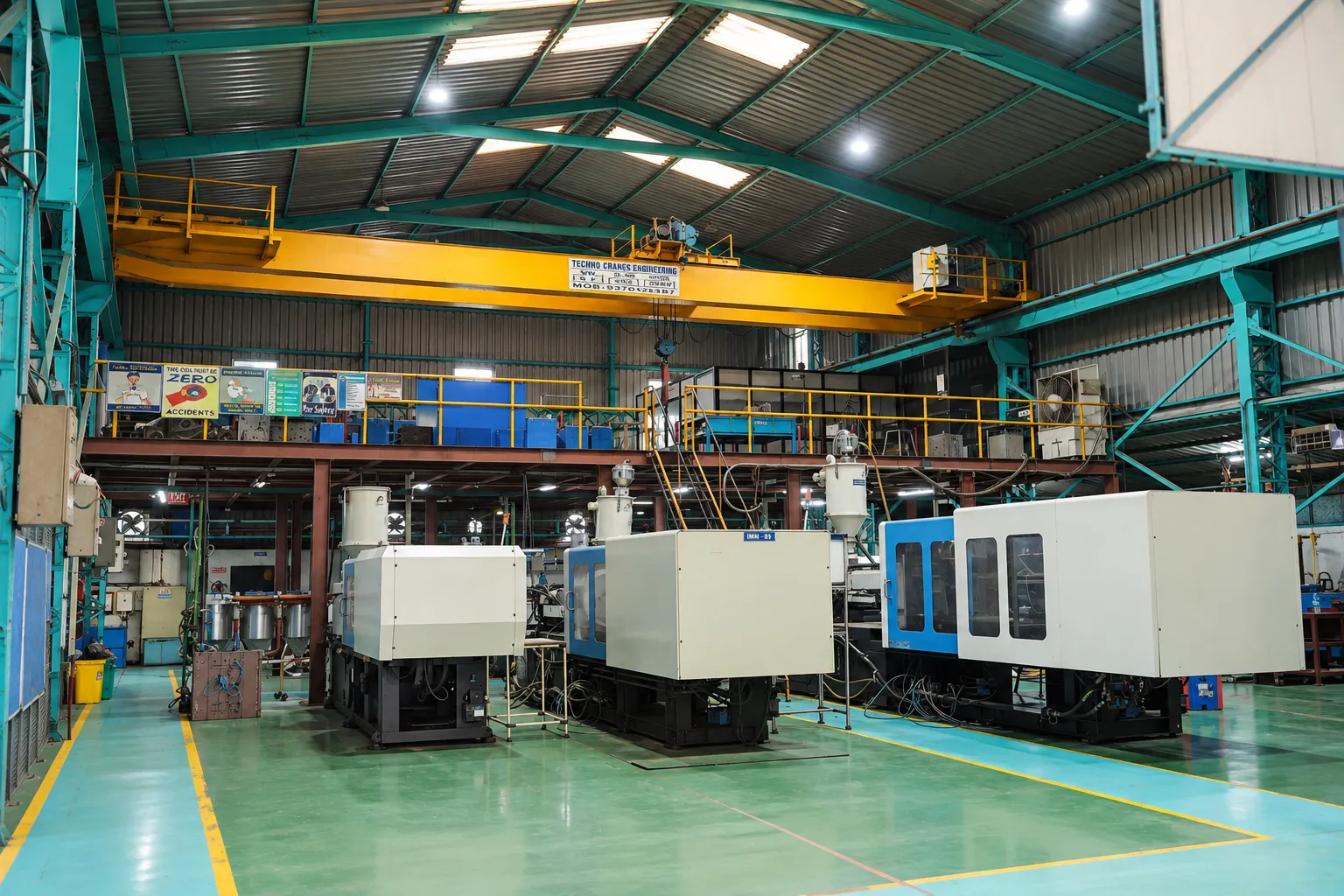
Our published range is 50T to 380T across horizontal, vertical and all-electric machines, enough to place most industrial components on an appropriately sized press.
What can they actually measure?
A supplier can only control what it can measure. Ask specifically:
- What measuring equipment is available, and is it calibrated?
- How are first-article dimensions verified against the drawing and the CAD model?
- What is checked during production, and how often?
- What records are kept, and will you receive them?
Vague answers here are a meaningful warning. Our own inspection protocol is structured as first-article inspection, in-process verification and a pre-shipment audit, with the measuring equipment listed openly.
How is material handled?
Material handling is unglamorous and disproportionately important. Hygroscopic polymers (PA6, PA66, PC, PBT) must be properly dried, and "properly" means verified dew point and verified material temperature, not simply a heater running.
Worth asking: how is incoming material verified, how is regrind used and controlled, and how is material traceability maintained from batch to shipped part. If a supplier cannot tell you which material batch produced a given consignment, they cannot investigate a field failure.
Is the process documented or remembered?
Ask whether process parameters are recorded for each tool and each material, and what happens when a tool is set up again after several months. A supplier who works from documented setup sheets will reproduce a part; one who relies on an experienced operator's memory will reproduce it only while that operator is available.
This is also what makes defect investigation possible. Without recorded parameters there is no baseline to compare against when something changes.
Commercial terms worth settling early
Tool ownership
If you pay for the tool, establish in writing that you own it, and agree the conditions under which it can be moved. This is the single most common source of difficulty when a customer later wants to change supplier. Clarify it before the tool is cut, not afterwards.
Tool maintenance and life
Agree who maintains the tool, at what interval, and who pays for wear-related refurbishment versus damage. Agree what the tool is specified to produce, and what happens when it approaches that figure.
Sampling and approval
Agree how many sampling rounds are included, what constitutes approval, and who bears the cost of changes arising from a design revision as opposed to a tooling error. These are different things and should be treated differently.
- Can I see the toolroom as well as the moulding floor?
- What would this part run on, and why that machine?
- Show me a first-article inspection report for a current job.
- How is material dried, and how is that verified?
- Where are process parameters recorded?
- How is a tool corrected after first sampling?
- Who owns the tool, and what are the terms for moving it?
Reading the quotation itself
A quotation that separates tooling from piece price, states cavity count and cycle time, and raises design observations reflects genuine engineering review. One that provides a single number with no breakdown may be competitive, but you have no way of knowing what has been assumed, or what will be raised as a variation later.
The cheapest quotation is often the one with the most assumptions embedded in it. Comparing suppliers properly means first ensuring they are quoting the same scope, which is why what you send with the enquiry matters as much as who you send it to.
Evaluating a manufacturing partner?
We are happy to walk through tooling capability, machine selection and inspection methodology for your specific component before any commitment.
Request a Quote View Capabilities